
Does your child start homework… then suddenly remember they need to rearrange their stuffed animals? Or begin a worksheet only to ask, “What was I doing?” five minutes later?
You’re not alone. In a world of screens, notifications, and fast-paced entertainment, helping kids build focus can feel like an uphill battle. But here’s the good news: focus is not a fixed trait—it’s a skill. And like riding a bike or tying shoes, it can be taught—step by step.
This guide breaks down realistic, science-backed strategies to help children aged 4–10 improve attention, reduce distractions, and stay on task—without pressure or perfection. No magic tricks, just practical steps you can start today.
Let’s build your child’s focus muscle — one small win at a time.
Why Kids Struggle to Focus (And Why It’s Not Their Fault)
Before we dive in, it’s important to understand: short attention spans are normal for young children. A 5-year-old typically focuses for 5–10 minutes per year of age. That means a 6-year-old might focus for 6–12 minutes on a new task—and that’s okay.
But some factors can make focus harder:
- Too much screen time
- Lack of sleep or poor nutrition
- Overstimulating environments
- Underlying needs (like ADHD, anxiety, or sensory processing differences)
The goal isn’t to force kids to sit still for hours. It’s to gradually expand their ability to pay attention when it matters—like during homework, listening to instructions, or finishing a project.
Step 1: Start Small — Use the “Just 2 Minutes” Rule
Trying to get a distracted child to focus for 20 minutes? That’s like asking a beginner to run a marathon.
Instead, start tiny.
Tell your child: “Let’s just focus for 2 minutes. Then you can take a break.”
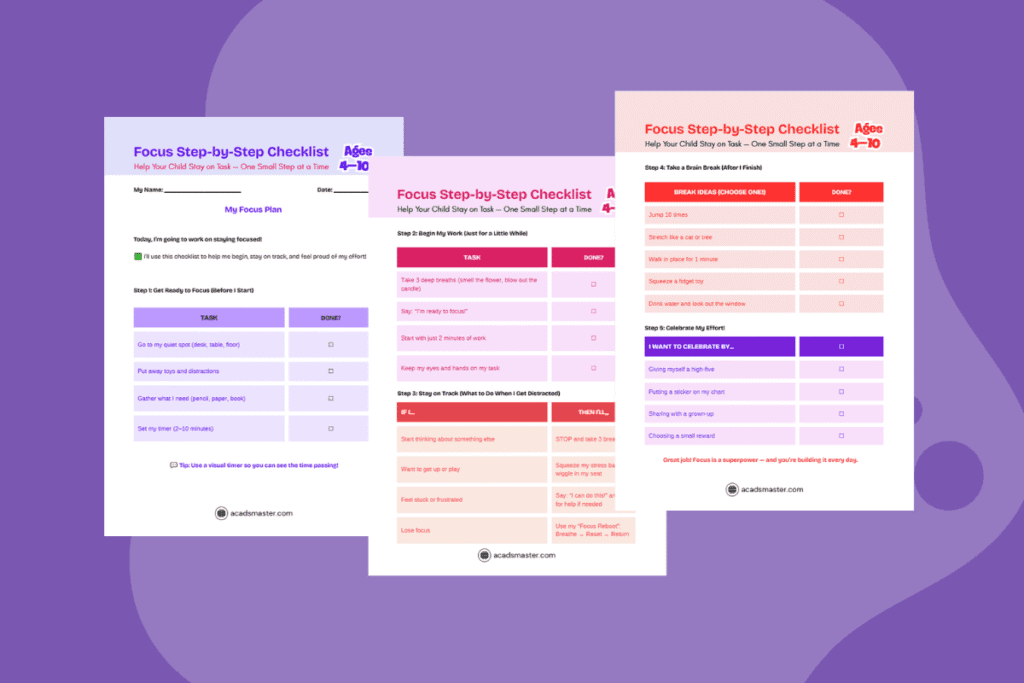
Use a visual timer (like a Time Timer) so they can see the time passing. When the 2 minutes are up, celebrate:
“Great job! You stayed on task the whole time!”
Gradually increase the time — 5 minutes, then 7, then 10 — as your child builds confidence.
🧠 Why it works: Small wins build motivation. Success breeds more success.
Step 2: Reduce Distractions (The Quiet Zone Method)
Kids can’t focus in chaos.
Create a “Quiet Zone” for focused tasks — even if it’s just a corner of the kitchen table.
What to do:
- Remove toys, screens, and clutter from sight
- Use noise-canceling headphones or soft background music (like instrumental or lo-fi beats)
- Turn off notifications on phones and tablets
Real-life example: One family noticed their 7-year-old kept getting up during homework. They moved the workspace to a quieter part of the house, put away nearby toys, and used a small lamp to define the space. Within days, the child stayed seated longer and finished assignments faster.
Tip: Let your child help set up the space. Ownership increases cooperation.
Step 3: Use Focus Boosters (Movement & Sensory Tools)
Believe it or not, movement helps focus — especially for active or wiggly kids.
Try these before or during focus tasks:
- 2 minutes of jumping jacks or wall push-ups
- Chair squats (sit/stand 5 times)
- Squeezing a stress ball
- Chewing crunchy snacks (apple slices, carrots)
These “brain breaks” reset attention and calm the nervous system.
For kids who need more support, consider:
- Wobble cushions
- Fidget tools (small, quiet, non-disruptive)
- Weighted lap pads (consult an occupational therapist if needed)
Note: Fidgets should help focus — not distract. If it’s a toy, it’s not working.
Step 4: Break Tasks into Tiny Steps
Big tasks = big overwhelm.
Instead of saying, “Do your homework,” break it down:
- “Take out your math sheet.”
- “Read the first problem.”
- “Write your name at the top.”
- “Do just the first two questions.”
Use a checklist with words or pictures. Let your child check each box — the sense of progress keeps them going.
Why it works: Clear, small steps reduce anxiety and make tasks feel doable.
Step 5: Teach the “Stop & Reset” Technique
Even adults lose focus. The key is knowing how to get back on track.
Teach your child a simple reset:
- Stop what they’re doing.
- Take 3 deep breaths (smell the flower, blow out the candle).
- Say: “I’m ready to focus again.”
- Go back to work.
Practice this during calm moments — not in the middle of a meltdown. Make it fun: call it “Focus Power Mode” or “Brain Reboot.”
Real-life example: A parent taught this technique to their easily frustrated 8-year-old. When the child started drifting off during reading time, they paused, took a breath, and said, “Rebooting!” It became a lighthearted way to regroup — and reduced nagging from “Just pay attention!” to zero.
Step 6: Build Focus with Play (Yes, Really)
Some of the best focus-building activities feel like play:
- Puzzle time (jigsaws, Sudoku for older kids)
- Listening games (“I Spy” with sounds, “Simon Says”)
- Board games (like “Uno,” “Spot It!”, or “Blink”)
- Follow-the-leader obstacle courses
These develop sustained attention, impulse control, and listening skills — all while having fun.
Pro tip: Start with 5–10 minutes and gradually increase play time.
Step 7: Celebrate Effort, Not Just Results
Praise what you want to see more of.
Instead of: “You finished your worksheet!”
Try: “I saw how you kept going even when it was hard. That’s focus!”
Specific, effort-based praise builds confidence and reinforces the behavior.
Avoid comparing siblings or saying, “Why can’t you focus like your brother?” — it shuts down motivation.
Conclusion
Teaching kids to focus isn’t about demanding silence or forcing stillness. It’s about guiding them with patience, structure, and support — one small step at a time.
You don’t need a perfect environment or hours of training. Just consistency, a few smart strategies, and a willingness to meet your child where they are.
Start today: pick one tip — maybe the 2-minute rule or a quiet zone — and try it. Celebrate the effort. Then try again tomorrow.
Because every time your child notices they’re distracted and chooses to refocus? That’s not just attention. That’s growing a superpower.
Frequently Asked Questions (FAQs)
Q: How long should my child be able to focus?
A: A general rule: 2–5 minutes per year of age. A 6-year-old may focus for 12–30 minutes depending on interest and task type.
Q: My child has ADHD. Will this help?
A: Many of these strategies are used in ADHD coaching. They’re supportive — but not a substitute for professional care. Always work with a specialist if needed.
Q: Should I use rewards?
A: Short-term rewards (like a sticker or extra story time) can help build habits. Phase them out as focus becomes routine.
Q: What if my child refuses to try?
A: Start with something they can do for 1 minute (like coloring). Build from there. Keep it light and positive.
Q: Does screen time affect focus?
A: Yes. Fast-paced videos and games can overstimulate the brain. Limit high-intensity screens before learning tasks.





No comments yet. Be the first to comment!
Please log in to post a comment.